Soursops, Sugar Apples and Rat Apples


      Friends of the VI National Park staff gave away plants and tree seedlings to community members. .  


On April 20, the Friends of the Virgin Islands National Park on St. John attracted an enthusiastic crowd for their Earth Day related plant and tree giveaway. The first giveaway was held in 2020, and the event was initiated to help local families replace some of their trees that were blown away by the 2017 storms. 


The fruit-bearing trees are by far the most popular. Many people love to grow their own food, even though island conditions can be quite challenging. For the last few years I have saved my Sugar Apple and Soursop seeds to sprout, and have raised seedlings to share with my neighbors, at this event and at the Unitarian Universalist Fellowship’s annual plant celebration ceremony. 


   Soursop trees were popular at the Friends of the VI National Park event. 


I have recently been considering some ideas, including from Indigenous writer and botanist Robin Wall Kimmerer, about feeling kinship with trees rather than viewing them as commodities – and how that perspective would benefit us, as well as the survival of all forms of life on the planet. 


Kimmerer points out that in some Indigenous languages the word for plants means ‘the ones who take care of us’. They are, after all, the ultimate source of almost all our food, and the only ones capable of photosynthesis.    


It is an intriguing perspective, but I am not sure we are ready to treat trees as other beings with their own sorts of intelligence, rather than as objects for our use or disposal. It is difficult to give up the feeling that we are entitled to dominion over nature, and to recognize plants and trees as fellow creatures with their own wisdom, experience, and entitlements. 


Still, kinship is not always based on genetic ties, though we do share many genes with plants. We may have parental feelings as we raise trees from seeds, proud when they grow up to be beautiful and successful. Or we may be neighbors, sharing our common joy in good weather and spring rains, or distress at being battered by autumn hurricanes. 


Or we might have a complex transactional relationship, like I have with the Sugar Apple tree in my yard: “I take care of you, and you give me some of your fruit, and after I have eaten it, I plant your seeds, and pass seedlings along to my friends and neighbors, spreading your genes and offspring all over the island.”


      A Sugar Apple in our yard provides sweet treats, and I share the seeds.


We mostly value trees for the products and services they provide. Because Sugar Apples and Soursop trees have tasty fruit, I want to grow more of them. Yet from one perspective it might seem like they are manipulating me based on my fondness for sweets. I have been serving them as a seed disperser and propagator, like the birds do. We definitely have a reciprocal relationship of sorts.


Meanwhile the Rat Apple trees by my house don’t offer fruit that appeals to me and don’t seem to want anything from me except to be left alone. They were on the property before I came and mostly have no trouble taking care of themselves and their seedlings. 


         A Rat Apple with flowers, buds and woody fruit.


 What value do these trees have? Maybe negative value if fruits rats come too close to the house. But now that I have learned to recognize the Rat Apple trees, I have actually come to respect them, to some extent, as welcome companions on the land. Learning the names of the trees, even if the local name is not very flattering, definitely creates a form of recognition.  


The Friends of the VI National Park group has established a plant nursery across the road from Cinnamon Bay where they have been raising native trees, as well as some of the popular fruit trees that were just given away. 


           Sugar Apple seedlings at the FONP nursery 


Some of the native trees are being planted along the National Park shorelines to replace vegetation lost in the storms and help prevent further erosion. Other seedlings are being raised to preserve species that have been on the island for many generations and now need some help with propagation and survival – before their names and contributions are forgotten. 


Perhaps in the future those trees will be able to provide needed assistance to us and our descendants. If we have good relationships with them.   


Elegy for the St. John Baobab Tree


Oh our dear Baobab, how can you truly be gone? You stood tall on the ridge for so many years, and then survived the two terrible hurricanes in 2017, only to be hollowed out and brought down by a throng of larvae from invasive borer beetles. 

You were badly battered by the storms, and lost parts of your upper branches. But when the skies cleared, we rejoiced to see that you were still standing.


Soon tiny new branches sprouted from your fleshy trunk, and we thought how great that you were able to compensate for your losses and start anew. By the pandemic summer of 2020, you were bursting with blossoms and lifted the spirits of those who made the hopeful pilgrimage down the L’Esperance trail to witness your exuberant flowering. 


Although your fabulous flowers would only last for one day, we thought you had fully recovered your life force and would live on into the next century. 


The bees returned to their spot in the crease of your trunk, and rebuilt their hive, feeding on your pollen and nectar even though the flowers were more designed for attracting the night-flying bats as pollinators. 


Sadly, that burst of energy was your last. By the following summer your limbs were crippled by the thousands of larvae laid by the big beetles that bored into your broken places. Your porous, pulpy trunk, which from the outside seemed as strong as an elephant, offered little resistance to its tiny attackers. And was quickly consumed.

Did you already know the summer before that your time was up, after the first generation of beetles arrived? Is that why you threw off so many flowers, hoping to preserve at least some legacy for future generations? You must have also known though that, without a partner to fertilize them, your flowers had never produced viable seeds throughout all those long, lonely years.Still the flowers were lovely, and filled the glorious pandemic summer days with delight for bees and birds and human witnesses, and charmed the bats at night.

There have been baobab seeds brought here from other islands in recent years, and young baobab seedlings might someday attract as many admirers as you once did. I even have a fragile baby baobab, still in a pot, that I tried to raise myself, thinking about providing you one day with a mate to fertilize your flowers.


 I never thought that I would outlive you. 

When I wrapped my arms around you years ago, I was drawn to your strength. And then when I pressed my cheek to your trunk, I felt that I too could be strong, as it turned out I would need to be, for those who would come to lean on me. I didn’t know all the challenges ahead, and still don’t. 

There will be more losses to come, but I need to say now that you brought me days of unexpected joy that I will always cherish.


Pollinators Flock to the Painkiller Tree


Flambeau butterflies visited the flowers of the painkiller tree, aka starvation fruit. 


People have been remarking that there are very few butterflies this season. Maybe because it was so dry, before our recent weekend of rain. 


I have hardly seen any butterflies in my yard. However, when I went to the beach, I noticed that there were swarms of them on the flowering Morinda citrifolia trees, which are apparently quite drought tolerant. They are known locally as ‘painkiller trees’ or ‘starvation fruit’. In Hawaii they are called ‘noni’ and the fruit (which is not generally eaten in the Virgin Islands), has become popular as a health food. 


The painkiller name is not related to the potent rum drink, but to the traditional use of the  large leaves to wrap and sooth sore muscles. It is native to Asia and has become naturalized in the Virgin Islands, probably because it is so attractive to pollinators.    


The first butterfly I noticed was a Flambeau (Dryas iulia) which has bright orange wings with dark lines. There are only a couple of stripes on each wing, so it is easy to distinguish them from local Monarch and Gulf Fritillary butterflies – which also have orange on their wings but more patterning. These butterflies drink nectar and eat pollen, and help the tree make fruit by passing some of the pollen on to the next flower. However, the Flambeaus will mostly lay their eggs on the Passionfruit vine, their host plant, rather than on the painkiller tree. 


This Great Southern White butterfly dipped its proboscis into one of the small flowers. 


Great Southern White butterflies (Ascia monuste) also found these flowers. Some years we have enjoyed huge numbers of these white butterflies, but it seems there wasn’t enough rain this year at the right time for a big hatching. We’ll see if the recent rain makes a difference. These butterflies are important pollinators for many plants but in the Virgin Islands usually lay their eggs on the Limber Caper trees.   


A small Choranthus vitellius butterfly rested for a moment on one of the green fruits. 


Another smaller species of butterfly, Choranthus vitellius, fluttered around a different painkiller tree. I hadn’t seen that one before and had to look it up. It is a type of ‘skipper’ – called that because it darts around so quickly. It has a small, thick body, more like a moth, and antennas with tiny hooks on them.    


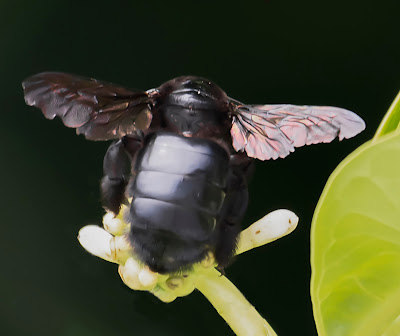
A big female carpenter bee plopped down on a stalk of flower buds.


And it wasn’t just butterflies that were attracted to the painkiller trees. Some large native carpenter bees (Xylocopa mordax) also came to the small flowers to enjoy some hard-to-find nectar and pollen.


Jack Spaniard wasps also have a taste for nectar. 


The Polistes crinitus wasps, known locally as Jack Spaniards, came too. Wasps are related to bees and also enjoy the sweet nectar, though they don’t make honey with it. They do provide pollination services, though, as they move from flower to flower. 


A female Antillean Crested Hummingbird rested on a branch near the painkiller tree


Hummingbirds like nectar too, and can also serve as pollinators. They are so fast they move like a blur around the tree, so it is hard to actually catch a photo of them on a flower. However, they rest in between nectar-seeking missions, and it is easier to get them in focus when they are sitting on a branch.  


While the green fruits of this tree may have nutritional or medicinal virtues, they become soft and pale when they are ripe and have a smell that has been described as ‘vomit-like’. Hence, the name ‘starvation fruit’, suggesting that they are only eaten when there is nothing else available, like after a hurricane. The funky smell of the ripe fruit is probably designed to attract fruit bats, which then help disperse the tree’s seeds. 


Pearly-eyed Thrashers will check out painkiller fruits to see if they are soft enough.


When the soft fruits fall on the ground, they become squishy walking hazards, especially if they are partially hidden in the sand along a popular beach. But some birds are happy to eat the smelly ripe fruits, including the omnivorous Pearly-eyed Thrashers. I also recently saw a sad-looking chicken at Hawksnest beach on St. John tucking into a squishy one on the ground, probably feeling lucky to find that life-saving starvation fruit. 


The island certainly looks much greener after the recent soaking rain, so maybe we will soon be treated to an outburst of new flowers and hatching butterflies, and not just on the painkiller trees. 


Rarely Seen Residents Show Up for the Annual St. John Bird Count

Yellow Warbler 


Some birds are willing to interact with people, while others prefer to avoid humans as much as possible. Bananaquits, for example, are happy to come get sugar from people’s feeders and are not shy about hanging around in the yard waiting for food. But Yellow Warblers, our only resident warblers, have no use for sugar. They are insect eaters and prefer to stay near the wetlands. 


Bananaquits


The annual Christmas bird count sponsored by the VI Audubon Society was held on December 19, 2020. Most of the people counting birds around their homes and neighborhoods checked off seeing the well-fed Bananaquits – 248 were reported – but only three people saw a Yellow Warbler. Pearly-eyed Thrashers are also very visible (88 were counted), though less appreciated than Bananaquits, because they eat the fruits in people’s yards without permission. 


Many local birds are shy and secretive, though, so most people never even know they are around. 


Caribbean Elaenia


For example, it was years before I saw a Caribbean Elaenia, which is supposed to be fairly common, and even longer until I got a good photo. The first time was way out on a forest trail, and the bird was flitting around in the leaves, so I didn’t get a good look. Later, National Park Ranger Laurel Brannick heard some of them singing their special three-note song up in a dry scrubby area near her house. I waited around for a while until eventually one sat down on a branch nearby and posed for me, which was very satisfying. Besides flies and other insects, they also eat small fruits in the forest. (Only six of them were counted in 2021.) 


Mangrove Cuckoo


More people on St. John have seen Mangrove Cuckoos than the Caribbean Elaenias, but the cuckoos are also pretty secretive. Three were counted in 2021, and 10 the year before. They are beautiful birds, though definitely more often heard than seen. They have a long, croaking gak-gak-gak song that some people say sounds like a monkey howling. Though they mostly hang around in the mangroves searching for caterpillars, spiders, lizards and berries, they can also sometimes be found or heard at higher elevations.   


Clapper Rail


While White-cheeked Pintail ducks (147 counted) and Black-necked Stilts (52) tend to be easily visible swimming in island ponds, Clapper Rails usually stick to the edges, skulking through the mangroves. (Only four were counted.) Though their calls are loud and clattering, it took several years of bird watching before I saw one out in the open. They are about the size of chickens, with long bills that they use to poke in the mud for fiddler crabs and insects. They will also sometimes run out into the pond to grab a small fish. 


Green Heron


Green herons keep watch over their ponds, cackling out warnings when strange birds or other intruders appear. They catch fish but are not swimmers. Instead a Green Heron will wade out, or walk along a low branch, and watch carefully for motion in the water, then stretching out its neck really quickly to make a strike. Or it walks along the edge poking around for fiddler crabs and insects. Green Herons don’t go far from their ponds, and sound an alarm if people get too close. Seven were counted in 2021.


Yellow-crowned Night Heron


A Yellow-crowned Night Heron hunts the land crabs that come out at night, stabbing holes in their shells with its thick bill. The night herons usually hide out during the day and rest, and you mostly only see one when you enter its territory and disturb it. They don’t seem particularly frightened though, and will stay nearby to see what’s going on. Three were seen on the count day. 


Least Grebe mother and baby 


I have seen a family of Least Grebes in a small pond across from a heavily used beach, in plain view but invisible to most people walking by. Others are likely hidden in other ponds around the island. Three were counted for 2021, and eight the year before. These are attractive diving ducks with golden eyes. They mostly eat aquatic insects.  


These are just a few of the resident birds sharing the islands. They may be hidden from many of us, but it is important to know that they are here too, and worthy of respect. I am always delighted when I can quietly share their spaces for a little while.  


Baby Ducks Are Showing up in Virgin Islands Ponds


                                                A young white-cheeked pintail duck sets out on its own.


White-cheeked pintail ducks are year-round residents in the Virgin Islands. Given the climate, they can mate pretty much any time, as long as there is enough food and water. Other ducks, like blue-winged teals, are migratory – they come down for the winter season, then move north again to breed. 


Some of the pintails must have been busy partying around the holidays because groups of baby ducks have appeared recently in local salt ponds. 


                    A white-cheeked pintail led her ducklings across the pond near Francis Bay on St. John. 


These handsome ducks are native to the Caribbean and South America. Both males and females have white feathers on their faces below their eyes and bright red patches on their bills. Their eyes are red as well. When they raise their wings, you can see patches of green on the edges.


                                . 


From what I have seen, mating activity can be rough. The female must have had to hold her breath as this male climbed on her back, grabbed her neck and pushed her head underwater. 


                  When ducks mate in the water, the female underneath seems in danger of drowning. 


It takes almost a month for the eggs to incubate. The nests are on the ground hidden in dense vegetation in brackish wetlands and mangrove swamps. The nests don’t seem very safe, though, as they are vulnerable to attack by rats, dogs, and other birds in the wetlands – including yellow-crowned night herons and smooth-billed anis. In the Virgin Islands, a mongoose might also eat the eggs or snatch a baby duck. 


When the babies are old enough, the mothers will lead them to a nearby pond and teach them to feed themselves. They are pretty vulnerable to predators there too. It can take up to two months before they are able to fly. Large groups of baby ducks seem to dwindle over time even though the mothers try to protect them, and males also sometimes help guard the family.  


                  A mother white-cheeked pintail brings her ducklings out to learn how to forage.  


The white-cheeked pintails are pretty particular about the depth of the water in a pond because they are dabblers, not diving ducks. In shallow water they walk around pulling up weeds and eating little fish, crabs and snails. 


                         White-cheeked pintails prefer shallow water when they forage for food. 


If the water is deeper, they dip their heads under the water with their butts up in the air while they search for aquatic plants and animals along the bottom. (They get their name from the pointy feathers on their butts.)    


                                        Dabbling ducks put their heads down to forage underwater. 


They can dive down if necessary, though they will generally move to a different spot if a pond gets too deep after weeks of rain. They will also move on when there is only mud left during the dry season.   


When a white-cheeked pintail is flying or stretching, you can get a better view of the colored patch on its wing, which is called the speculum. Many ducks have bright iridescent feathers on this section of their wings, close to their bodies. The varying colors help us to distinguish different types of ducks, and may also help the birds recognize members of their flock when they are flying. 


          When white-cheeked pintails are swimming you can’t usually see the green patches on their wings. 


Sometimes when one of the ducks rears up and flaps its wings, it looks like it is delivering a benediction. At least I have chosen to interpret the gesture that way. Probably it is just stretching its wings.      


                         A blessing from a friendly duck? 

A Lone Bufflehead on St. John - December 2021


There’s a very unusual duck on St. John. It’s over in the small pond behind Frank Bay that is designated as a bird sanctuary. During the day, it has been hanging out in the middle of the pond diving down to get food – they mostly eat underwater plants, small crustaceans and insects.    


I have seen a number of migratory ducks that regularly visit the Virgin Islands in the winter, including blue-winged teals, green-winged teals, ruddy ducks, scaups, and last year a northern shoveler. But no buffleheads, so I was eager to check it out.  


The bufflehead was first spotted by Victoria Beasley, a wildlife biologist for the Virgin Islands Department of Planning and Natural Resources, Division of Fish and Wildlife (DFW). She has been conducting waterbird surveys on St. John over the past year as part of a DFW Wildlife Restoration program supported by the U.S. Fish and Wildlife Service. “I was out on a regular survey at Frank Bay when I noticed a duck I did not immediately recognize. I had an ID book on hand that I quickly referenced and there was no mistaking that this was a bufflehead duck. Based on its known home range, I knew this was a very rare and notable sighting. I have since gone back to Frank Bay several times, and a month later this adventurous duck was still enjoying its time at Frank Bay. I highly recommend stopping by and seeing it for yourself.”


If you do go look for it, you might not see it right away because it spends a lot of time under the water. It will make a short dive, surface, and then quickly dive down again. You might only catch its long, stiff tail as it takes its next dive. Buffleheads rarely come on land.


Herbert Raffaele, author of a well-known guidebook Birds of Puerto Rico and the Virgin Islands (1989), noted that the bufflehead was ‘accidental’ in the West Indies, “known only from a single specimen collected in the late 1800s in Puerto Rico”. A more recent online app – All Birds, Puerto Rico, Virgin Islands and northern Lesser Antilles – records two sighting on Puerto Rico in December 2013, and one in St. Martin in 2004.


I am familiar with buffleheads because some of them winter around New York City. In fact I got up close to one in Jamaica Bay on Thanksgiving Day. The males are most noticeable because of their stylish black and white look. 


Then up close you can see that there is green and purple iridescence on the feathers around their heads and necks. 


The name is short for ‘buffalo head’, because sometimes they puff up their forehead feathers, which makes their heads look even more prominent and bulbous. 


They are also sometimes called ‘spirit ducks’, maybe because they disappear and reappear so quickly, and sometimes suddenly pop up on the other side of the pond. Like a watery ghost.


If I hadn’t been told about it, I might not have recognized the Frank Bay bird as a bufflehead because females look so different from the males. They have dark brown heads and backs, gray/brown bodies, and just a small patch of white on their cheeks. Later I realized that I had seen them before in New York too, but hadn’t paid much attention because they were so much less flashy than the males.    


Buffleheads generally spend the summer in Canada and Alaska, where they breed and raise their young. Interestingly, though they are diving ducks, they nest in trees, and in holes made by other birds, particularly the woodpeckers known as flickers. I guess it is safer for their eggs and babies to be up high and hidden, and their duck bills are no good for making their own holes in trees. They are quite small, weighing only about a pound, so they can fit into unused flicker holes. They also need to find trees near the water because the hatchlings will have to jump out of the nest hole and follow their mom to the water. 


After breeding season the buffleheads move south like many other birds, spreading out across the lower states and down into Mexico. They usually travel in small groups, rather than alone or in large flocks. Reportedly, one duck will keep watch on the surface while the others are going up and down foraging under the water. 


So how did this one on St. John end up coming so far east, and all alone? I read that bufflehead pairs are monogamous and tend to stay together for years. Did she lose him? Or decide to ditch him – just ducking under the water one day and popping up really far away, feeling that it was time to move on? 


It is often young male birds that wander, exploring new territories where there might be good habitat. Maybe this one is an especially spirited female duck. Plucky. 


I do hope she will stay for a while.  


A Bounty of Tropical Fruit - November 2021


There’s hardly anything better than picking fruit off the trees in your own yard. 

After the hurricanes, one of our sugar apple trees was broken off and leafless. However, unlike the mango tree and several other fruit trees, it was not permanently lost. A couple of years later it produced a remarkable amount of fruit on the remaining lower branches. Now the still-short tree is full of sugar apples again, and we are definitely thankful that it has recovered. 


The ripe sugar apple fruits are wonderfully sweet and custardy. However they don’t all get ripe at the same time, so you have to check them frequently to see if they are soft enough to harvest. Pick them too soon and they don’t ripen properly. Wait too long and the birds get to them first. 


I have been saving the sugar apple seeds and raising them in pots to plant in our yard – and to give away to other people who lost trees. Sometimes birds will also spread the sugar apple seeds around, and may actually have better sense than I do about where to leave the seeds so that they thrive.


We also have some papayas. These plants are giant herbs, not woody trees, and don’t usually last more than a few years even without storms. The fruits are delicious and also very good for your health – reputedly reducing your blood pressure and preventing heart disease, diabetes and cancer. How great to just go out and get one from the yard for breakfast or dinner.


The pearly-eyed thrashers compete with me for the ripening papayas. I suppose it is useful that they help spread the seeds around, but really, I would prefer to do that myself. Still, I’m not always quick enough to get to the papayas before the thrashers, and sometimes I pick them while they are still green, otherwise I won’t get any at all. You can eat them green, but they don’t taste as good to me. I prefer to put them in a paper bag on the counter until they ripen. 


I was surprised that my passion fruit vines survived over the summer while I was gone. Apparently, there was enough rain for them to flourish, and the deer left them alone. Their flowers are amazingly beautiful, and the ripening passion fruits look like shiny green Christmas tree balls.   


We usually eat the passion fruit pulp right out of the skin, seeds and all. But sometimes we use it to flavor drinks.  


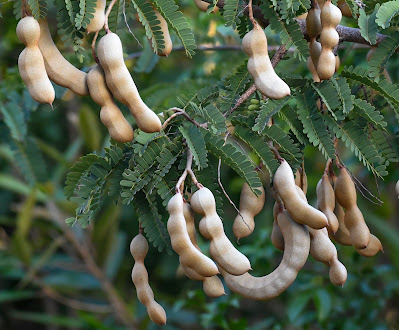
Meanwhile the two tamarind trees are full of juicy pods. They were on the land before we came, and have gotten really tall so it’s hard to reach the fruit. It’s worth it to try to grab some though. They are tangy if not fully ripe, but can be wonderfully sweet if you catch them just right. 


Only one of the coconut trees we planted is still alive. The others succumbed to hurricanes and droughts. We worried about this one, but now it has rallied. 


Besides providing tasty coconut water and sweet creamy meat, this tree also provides opportunities for our sons to show off their island climbing skills and machete work.


We are very grateful for the fruits of this season, and for another year of safety from storms.