Why Do Laughing Gulls Come to the Virgin Islands for the Summer?

An adult laughing gull has a black hood during breeding season. 

There are no gulls in the Virgin Islands during the winter, but then the laughing gulls suddenly arrive right around the first of April. And like other spring visitors, they tend to come in groups and enjoy loud, amorous beach parties.  

Laughing gull couples use buoys for offshore trysts. 

However the laughing gulls are known to be monogamous. Before long the couples will work together to make nests and raise their chicks out on the smaller, uninhabited cays. They usually stay together in large groups through the nesting season, for safety in numbers.    

I recently began to wonder where these laughing gulls actually come from, and why they are only around in the summer.  


Most migratory birds in the Virgin Islands arrive when it is winter in the northeast and food is scarce. Then they leave in the spring to go up north for their breeding season. In the fall, when it gets cold again in the northern parts of the U.S., those birds fly back down. 


These laughing gulls are on an opposite schedule – coming to the Virgin Islands to nest, and then leaving in the fall. 


One possible explanation could be that the Virgin Islands laughing gulls come to escape the winter in South America, where the seasons are reversed. However, the non-breeding range for these birds is mostly along the northern coasts of South America, and the Caribbean. The  seasonal temperature difference between these areas and the Virgin Islands would be fairly low. Meanwhile, they are considered to be year-round residents within some of the coastal areas of the Greater Antilles. 


So I am now thinking that the laughing gulls arriving yearly in the Virgin Islands have not actually traveled very far. And that they probably come for the relative safety provided by the smaller, uninhabited islands here, rather than for the warm summer weather. They may even be returning to the places where they were born and raised. 


The laughing gull nests are usually simple grassy structures set into low vegetation on the ground, so being isolated offshore could provide important protection from possible predators.   


In the summer, there are often large bunches of baby fish available around the Virgin Islands to feed hungry gulls, and their chicks. And these days, there are rafts of sargassum to pick over too. 


Groups of laughing gulls gather to dive for newly hatched fish.


Besides diving for fish (or trying to steal them from the pelicans), the laughing gulls will also walk along beaches and shorelines looking for shellfish, crabs and large insects. On popular beaches, they may also be attracted to trash left by humans. 


Beach walks sometimes reveal tasty crustaceans.


Interestingly, for the last couple of years there have been some laughing gulls staying in the Virgin Islands later in the fall than usual, including a few sightings recorded in the annual December bird counts on St. John. 


However, they look quite different when they are not in their breeding plumage. The black hoods become just blurry gray patches on their heads. 


Laughing Gulls lose their black hoods after breeding season is over. 


It takes about three years for the young ones to get their adult feathers. At first their back feathers are brown with white edges. Over time the feathers on top start turning gray.  


Immature laughing gulls have a mottled brown and gray look.


Unfortunately, large numbers of laughing gulls and other birds on islands or coastal areas near airports can sometimes be dangerous to air traffic, so air traffic controllers are not happy to see them around. In fact, just recentlya bird strike caused injuries to passengers on a small plane coming into St. Thomas. 


In the Virgin Islands, the U.S. Department of Agriculture’s Wildlife Services program is responsible for keeping birds from getting in the way of arriving or departing planes. Their researchers have found that patches of water collecting on the runways can attract thirsty gulls, so good drainage is important. Controlling insects so they don’t hatch in large groups on grassy areas near runways will also keep the gulls from congregating near the airport, which helps both visiting birds and people in planes stay safe.  


However, most of the laughing gulls aren’t all that interested in hanging around the airport. Like other visitors, I think they come to the Virgin Islands to enjoy the beautiful beaches.  


Local Kestrels Are Adapting to the New Composite Utility Poles


The replacement poles, made out of fiberglass and resin, are designed to be lighter, stronger, and more wind-resistant than the old wooden utility poles. Their installation was largely funded by the Federal Emergency Management Agency, and the Housing and Urban Development program, as part of a larger effort to strengthen the Virgin Islands grid infrastructure following the extensive damage caused by Hurricanes Irma and Maria.  


The wooden poles have now mostly been replaced, and already some concerns have been raised about the relative strength of the new poles. Especially when cars run into them. 


However, I wonder if much thought was given to how these new poles affect the birds living in the Virgin Islands. 


American Kestrels are small falcons (about 9-10 inches in length), with sharp wings, longish rust-colored tails, and prominent dark streaks under their eyes. They live year-round across much of the United States and the Greater Antilles, and are common nesting residents in the Virgin Islands. They can often be seen sitting on high perches scanning for the lizards they like to eat, along with occasional mice or large insects. They swoop down quickly to nab their prey, and then often return to the perch to eat.   


The flat tops on the old wooden poles provided platforms for important kestrel activities, including hunting, eating, courting and mating. 


But the new poles have pointed tops, specifically designed to prevent birds from perching on them. So the kestrels have had to adapt. 


The points on the poles may actually be intended to keep other types of birds from building nests up there. That is not a concern for kestrels because they make their nests in cavities, like holes in trees. They are more interested in platforms for hunting and mating. 


The arms supporting the wires on the new poles have now become important bird spaces, and the wires themselves are being more heavily used. The kestrels were quite noticeable this spring as they carried on their loud courtship activities. Near our house, their frequent loud meetups were hard to miss - and were conducted almost entirely on the wires.   


I usually saw the female land on the wire first. I knew it was a female because her back and wings were both brown, while the males have blue wings and brown backs. 


She might preen for a few minutes, or stretch out her tail. Then she’d start making loud, sharp “kee-kee-kee” cries, which is what usually caught my attention. But her calling out was not meant for me. Soon she would look around and lift her tail to beckon her mate.


He would fly over, possibly sit nearby for a few minutes, and then suddenly press tightly against her as one or both of them yelled noisily. Soon afterwards, they would fly off.


By contrast, they are quite secretive about their nests. Fortunately for me, one of my neighbors has a suitable tree hole for kestrel nesting right in front of his house, which is why there are usually some kestrels in our area. 


A couple of years ago I was able to hide under my neighbor’s deck and observe the babies peeking out, waiting impatiently for the parents to come feed them.  


Then later I watched the nestlings emerge from hiding and first test their wings. It took them a while to learn how to catch their own lizards, so for quite a long time they would stand on the utility pole equipment and screech for the parents to bring them something to eat.  


Overall, I don’t think the kestrels are as happy with the design of the composite poles. Still, they do seem to have figured out how to use the new equipment, and the wires themselves, to support their own purposes. So that’s good. 


A Passion Fruit Vine Sweetens the Dry Season


Passion fruit flowers attract many pollinators, including Jack Spaniard wasps


Ah, the idea of passion is so exhilarating, and the flowers present themselves to admirers with such abandon. Yet for us, their promise of sweet fruits has often remained unfulfilled. But this year we were actually blessed with a bowlful of yellow egg-shaped fruit to celebrate spring.   


I had cut the vine way back last summer because it seemed like it might be dead. Then In the late fall, when there was a lot of rain, I was happy to see that it perked up and started growing wildly - first up the fence and then all over a nearby tree.


I didn’t see any flowers, though. In February, one day we noticed a green passion fruit hanging in the tree. Very mysterious. The vine had twisted around the poor tree underneath it, and the leaves were all bunched up, so it was hard to see what was going on. Only the one fruit on the edge was easily visible, once you spotted it. But it turned out there were some others hiding inside the tangle, camouflaged because they were the same color as the leaves.  


A green passion fruit is hard to see among the leaves on the vine. 


I decided to leave the fruits on the tree until they dropped, rather than bringing them inside when they started to turn yellow. I wanted to see how long it would take for them to ripen naturally. (Often, if you put them in a paper bag they will ripen quickly on the counter.) These didn’t drop from the tree for a couple of months.   


In the meantime, after a bit of rain in March, I was excited to see some new flowers coming out. At first, they popped up on the vine like pods. Then the outer leaf-like sections opened, and white flower petals started breaking through. 


A passion fruit flower seems to burst out when it opens. 


Once the flowers were fully opened, they attracted bees, wasps and butterflies with their nectar. With passion fruit flowers, the nectar is produced below the flower at the base of the outer leaf. 


Large, solitary carpenter bees are major pollinators for passion fruit flowers. 


When big black carpenter bees come by to drink the nectar, their backs and legs get covered with pollen located on the (male) yellow anthers above them. Then when they go to the next flower, they transfer that pollen to the three-pronged stigma (female) part of the flower located higher up on the stalk. From there, the pollen gets drawn down inside into the flower’s ovaries, where fertilization of the ovule takes place, and the fruit can start to form.       


A carpenter bee moves on to the next flower carrying a load of yellow pollen. 


Transferring the pollen from one flower to another allows for cross-pollination, which mixes up the genes and allowing for better evolutionary adaptation possibilities. 


Different types of butterflies also came to eat nectar, and at the same time help with the flower’s pollination. A bright orange one was a Julia or Flambeau butterfly. 


A Julia (Flambeau) butterfly stops on a passion fruit flower for a taste of nectar. 


Once fertilization takes place, the flower’s ovary swells and slowly develops into the egg-shaped fruit we eat. 


The fruit develops in the flower’s ovary, with the three-pronged stigma still attached. 


Some of the passion fruits dropped from the tree while they were still green, then ripened after we brought them inside. One morning after I thought we had collected them all, I heard a little thump while I was out watering in the yard. I saw a Pearly-eyed Thrasher inside the tangled vine, and then looked down to find a new passion fruit on the ground. I felt like the universe had surprised me with the gift of a golden egg, and was happy to grab it before the ‘thrushie’ had a chance to bite into it.  


When the passion fruits get ripe, they look like yellow eggs. 


When you cut the fruit in half, there are lots of seeds inside, surrounded by a small amount of deliciously fragrant pulp. Sometimes I just eat the whole thing with a spoon, seeds and all. I have read that these seeds are full of nutrition and not toxic like some fruit seeds. Other times I put the seeds and pulp into a glass of water to soak and enjoy the sweet smell and delicately flavored juice that way. You can also use the juice to flavor elegant tropical cocktails.


I have also been spreading some of the seeds around the yard, in hopes that I will be able to grow more passion fruit vines for next year. 


A passion fruit is filled with seeds that are hard to separate from the pulp. 


St. John Scarlet Ibis Said Goodbye Again to Snowy Egret Friend


It’s March and once again the snowy egret has left the wetland area near my house in Fish Bay on St. John. I believe this same bird was friendly with the scarlet ibis last year and returned for the winter so they could hang out together again. Particularly the ibis.  


It is difficult not to project some kind of romantic story on these two, given how closely they stick together during their time together. And how unhappy they both look when the snowy egret is getting ready to leave.


I assume the snowy egret is leaving because it is time to breed, and that means going somewhere else to find a mate, as there is no snowy partner available in this pond. Since this snowy egret seems to be migratory, it would probably fly over towards the east coast of the US. Or possibly just to another island not so far away. I have read that some snowy egrets breed in this area, but I am not sure where. 


Of course the scarlet ibis could also fly over to Necker Island in the BVIs to look for a suitable partner from the flock there. But possibly that flock is too big now and there isn’t enough food to support a larger group. 


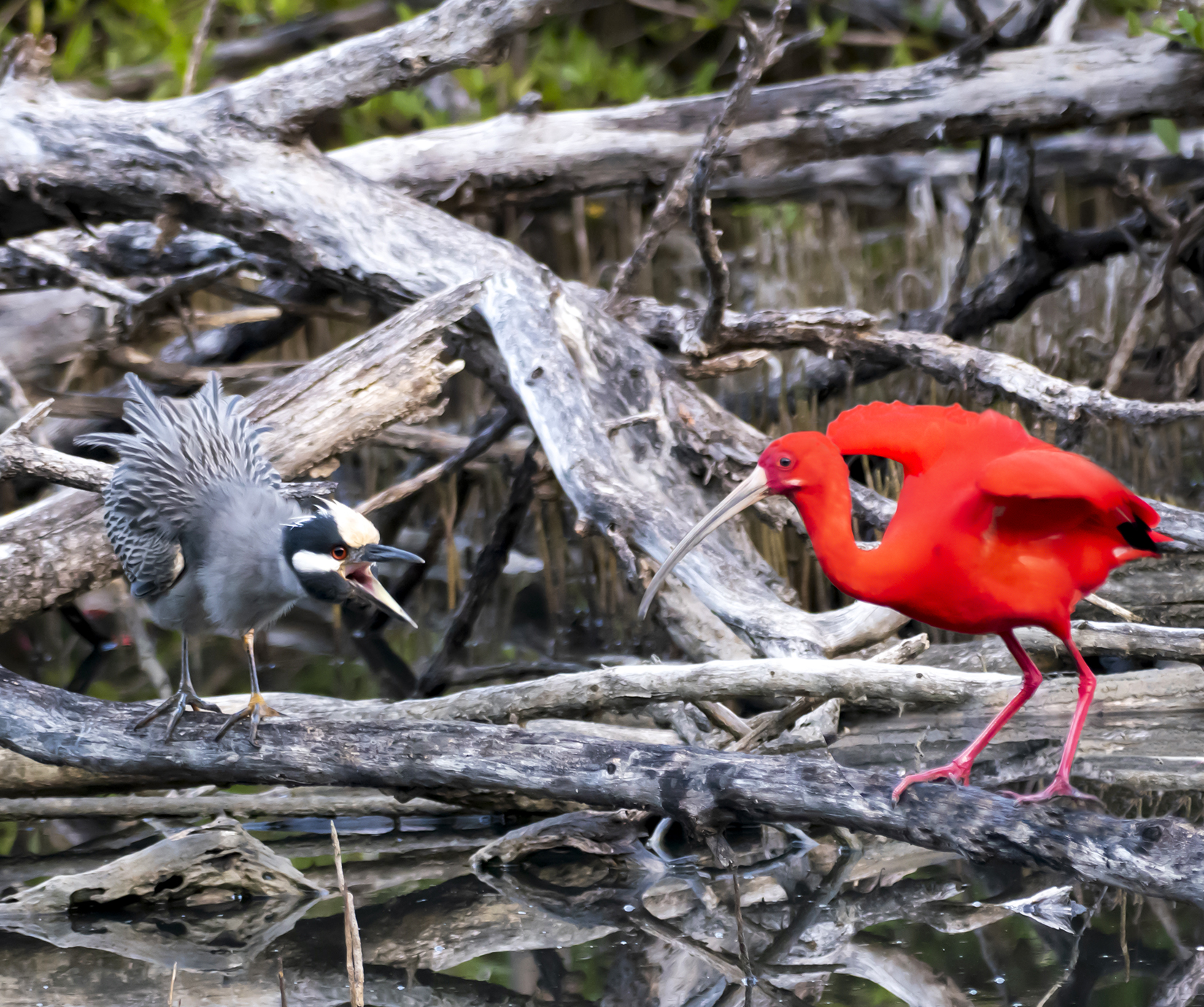
Since the snowy egret left, the scarlet ibis seems to be seeking out other companions. Sadly, an early morning visit with the yellow-crowned night heron did not go very well. The ibis dropped down too close and angered the normally placid night heron, which was probably getting ready to go to sleep after a hard night catching land crabs.  


Ruffled up feathers quickly led to threatening behavior from the night heron. After that, the scarlet ibis avoided another confrontation by sneaking behind the night heron to get to the other side of the pond.  


A little blue heron did let the scarlet ibis tag along at a short distance behind, ­­­­­I don’t think they will become pals. 


 While I am delighted to have the scarlet ibis hanging out nearby, I do feel this bird is a bit sad. But maybe I am just projecting.


Steer Clear of Jack Spaniard Wasp Nests


They seem to be everywhere these days. In our yard, on the deck rafters, along the edges of trails, and even underneath the car mirror! Because their nests are made out of a papery substance, they like to build where there is some cover overhead.  


Their nests are usually suspended from a thin strand called a petiole, and constructed out of a mixture of chewed up wood and plant fibers held together with saliva. The nests have small cells like cubby holes where the eggs are placed, and where the developing larvae are later fed. 


I really respect these wasps for their industrious building activity, but I still don’t really welcome them around our house because they have a frightful sting. I have read that they are not aggressive unless their nest is disturbed. However, the nests are often in places where you can brush by them unintentionally. If that happens, you should run away if you can. Unlike bees, these wasps can sting repeatedly. Though the venom in their stingers is designed to paralyze small prey, like caterpillars and soft insects, it can be quite painful to experience, and could even trigger allergic reactions in some people. 


The name Jack Spaniard (sometimes ‘spaniel’ or ‘spanna’) is used for several types of paper wasps found in the Caribbean. I thought the name might refer to the vicious sharp swords and steel-tipped lances carried by the Spanish conquistadors, though another theory is that their coloring looked similar to the uniforms of the Spanish soldiers.    


I was surprised to learn that there are actually two similar types of ‘Jack Spaniards’ in my yard. One type has the Latin name Polistes crinitus. They have reddish-brown abdomens with yellow stripes.  


The other type is Mischocyttarus phthisicus. These slightly smaller wasps have black abdomens with yellow stripes, except that the last segment is reddish-brown. Also their antennas are different in color than the larger wasps. (I couldn’t find information on other differences, so maybe will have to observe them more closely.) 


Besides eating caterpillars, both these wasps are attracted to sugary nectar. Their nectar-seeking visits allow them to carry pollen from one flower to another, and in the process to serve as valuable pollinators. 


I have also sometimes seen the wasps investigating sweet fruits. 


When wasps appear at the sugar feeders in my yard, the Bananaquits will usually take off. It seems like they too are afraid of getting stung. Not all birds are afraid of them though. Some insect eaters like Gray Kingbirds and Caribbean Elaenias will catch the wasps as they fly around.  


Like bees and other paper wasps, the Jack Spaniards have one queen who lays all the eggs. The other non-reproducing ones feed, support and defend the group in what is called a ‘eusocial’ arrangement. It appears to be working well for them. Although they were badly affected by the 2017 hurricanes, losing their homes as well as their food supplies, they have recovered well and seem to be thriving.  


A Young Flamingo Dances on St. John’s South Shore


Flamingos rarely come to St. John, so I was delighted that we had one here in December, just in time for the annual Christmas bird count. A group of adults and juveniles had been spotted at a different south shore pond back in October, but I had missed them. Maybe this was one that decided to stay on by itself, or to come back. 


When I first went by, the flamingo seemed to be doing a sort of dance as it preened its feathers. Or maybe it was just enjoying stretching out its wings and legs. 


Some of the poses were touching, especially when it tucked up its foot and wrapped its neck around as if giving itself a warm hug. 


My son pointed out that ‘flamenco’ is Spanish for flamingo, so maybe it wasn’t so surprising that these birds appear to be graceful dancers. At one point the flamingo even seemed to be inviting a pair of White-cheeked Pintail Ducks to join in the dance. 


This bird wasn’t the bright pink you expect from a flamingo, though. It takes the young ones several years to get their full color and, in the meantime, they have black and white feathers, and pale pink legs and throats. 


They also have to have a proper diet. Their pink coloration as adults comes from carotenoids in microscopic algae, which flamingos are able to metabolize to create pigments in their feathers. They can eat the algae directly, or get the carotenoids from eating brine shrimp or other tiny creatures that also feed on the algae growing in shallow, salty ponds. 


The way flamingos eat is really interesting to watch. They put their heads down under the water and shuffle their feet around to kick up edible stuff off the bottom of the pond. Their bills are facing their feet, and they use their tongues to push the kicked-up water through their mouths, while filter plates along the edges trap the edible bits.  


Eating behavior is not as graceful as the preening poses, mostly because the bird’s head is underwater. However, its shuffling feet move around in a circle, and you can imagine the joy of a whole chorus line of big pink birds dancing by.   


Looking at the flamingo standing upright, you can see that the lower part of the jaw is much thicker that the top part. That part is fixed to its skull and doesn’t move. Underwater, the thick part is on top as the bird faces backwards, and the thinner part flaps up and down to push food in the water into its mouth. 


There used to be quite a few flamingos in the Virgin Islands, but they died out not too long ago, probably due to a mix of hunting, hurricanes, predation and loss of habitat. 


In the British Virgin Islands, a small flock of flamingos was reintroduced in Anegada in 1992, and more recently another group was brought to Necker Island by Richard Branson. Those flocks have been breeding and growing, and some birds have spread to other parts of the BVI, with occasional visitors to St. Thomas and St. John that are enthusiastically welcomed.


It certainly would be fun for St. John to have its own flock of flamingos – a group is actually called a ‘flamboyance’. However, on Anegada the flamingos ended up moving to parts of the island inaccessible by road in order to avoid being aggravated by eager observers, so maybe they are really better off staying in more remote places.